How Digital Student Records Improve School Administration
Accurate student records are essential for smooth school operations. Discover how digital record management helps schools organize student information, reduce errors, improve accessibility, and make better administrative decisions.

VidyalayBox Team
Education Technology Team
How Digital Student Records Improve School Administration
Managing student information is one of the most important responsibilities of any educational institution. From admission forms and personal details to academic histories, certificates, and parent information, schools handle a large amount of data throughout the academic year.
When these records are maintained manually, even small mistakes can create administrative difficulties. Missing documents, duplicate entries, outdated contact details, and incorrect student information can affect everyday school operations.
Digital student record management software offers a more organized way to handle this information. By maintaining student details in a centralized system, schools can improve data accuracy, simplify administrative work, and make important information easier to access.
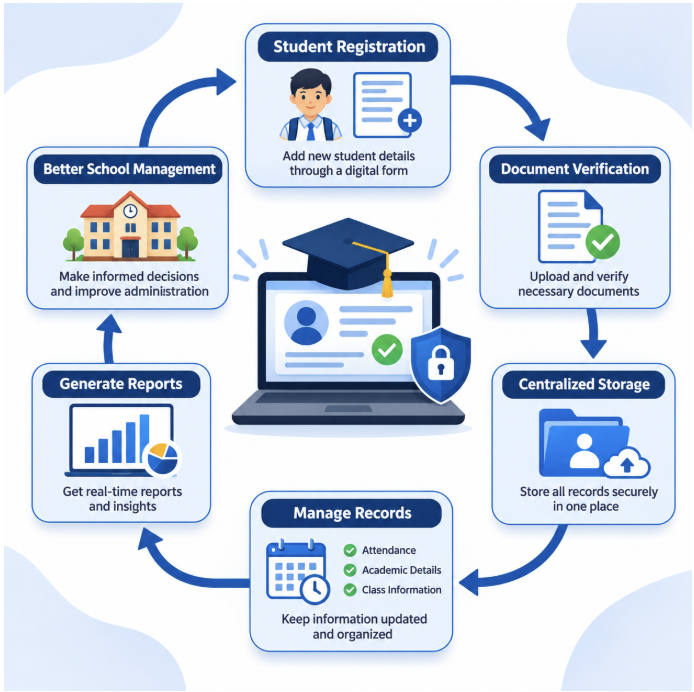
1. Maintain All Student Information in One Place
Many schools maintain student information across different registers, spreadsheets, physical files, and departmental records. This makes it difficult to find updated information whenever teachers or administrators need it.
A centralized digital record system allows schools to maintain essential information through individual student profiles.
These profiles can include:
-
Student names and personal details.
-
Parent and guardian contact information.
-
Previous academic records.
-
Admission and enrollment details.
-
Uploaded certificates and documents.
-
Attendance and academic information.
Having organized records reduces unnecessary paperwork and makes information retrieval easier for authorized staff members.
2. Reduce Errors During Student Data Entry
Incorrect information can create problems throughout a student's academic journey. A spelling mistake, incorrect date of birth, or outdated contact number may affect certificates, communication, and administrative reports.
Schools can improve data accuracy by following a structured digital data entry process.
Some useful practices include:
-
Using standardized admission forms.
-
Verifying information before final submission.
-
Checking duplicate student entries.
-
Updating parent contact details regularly.
-
Reviewing records before generating official documents.
Digital systems make it easier to maintain consistent records and identify information that needs correction.
3. Simplify Document Collection and Verification
Student documentation is another area where schools often experience administrative challenges.
During admissions, institutions may collect birth certificates, previous school records, photographs, identification documents, and other required paperwork.
Managing these documents physically requires storage space and additional time for verification.
Digital document management helps schools:
-
Store documents with individual student profiles.
-
Retrieve uploaded files when required.
-
Identify missing documentation.
-
Reduce dependence on physical files.
-
Maintain organized student records.
This approach also makes document verification more manageable during admissions and academic year transitions.
4. Make Student Information Accessible to Authorized Staff
Different departments require access to different types of student information.
For example, admission staff need enrollment details, teachers require academic information, and administrators may need broader institutional records.
A well-organized digital system can provide role-based access so that staff members can view the information relevant to their responsibilities.
This helps schools maintain a structured workflow while limiting unnecessary access to confidential information.
Access permissions should be reviewed regularly to ensure that student information remains appropriately protected.
5. Improve Record Continuity Between Academic Years
Student information does not become irrelevant when an academic year ends.
Schools need to maintain historical records for class promotions, transfer certificates, academic comparisons, and administrative verification.
Without proper record organization, retrieving information from previous academic years can become difficult.
Digital record management helps institutions maintain continuity by keeping student profiles organized over time.
Schools can use historical information to:
-
Verify previous enrollment details.
-
Review academic progression.
-
Maintain document histories.
-
Support class promotion processes.
-
Prepare administrative records when required.
This reduces the need to repeatedly collect information that the school already possesses.
6. Use Student Data for Better Administrative Decisions
Accurate information is useful beyond basic recordkeeping. It can also help school management understand institutional operations.
When student information is properly organized, administrators can review enrollment numbers, student distribution across classes, attendance patterns, and other relevant institutional reports.
These insights can support decisions related to:
-
Classroom and section planning.
-
Admission capacity.
-
Staff allocation.
-
Academic administration.
-
Student support requirements.
Instead of depending entirely on manually prepared reports, school administrators can use organized digital information to make more informed decisions.
7. Choose a System That Supports Complete Student Management
Moving from physical registers to digital records requires an appropriate technology solution.
Schools should evaluate a system based on its ability to manage student information, maintain documents, support administrative departments, and provide secure access.
Important features to consider include:
-
Centralized student profiles.
-
Admission and enrollment management.
-
Document storage and verification.
-
Attendance and academic record management.
-
Role-based access permissions.
-
Reporting and data export options.
-
Regular data backups.
A comprehensive school management software solution can bring these administrative functions together, reducing the need to maintain disconnected records across multiple platforms.
VidyalayBox provides student information management, admission management, document storage, attendance tracking, and other school administration capabilities through an integrated platform.
Schools can explore its features at VidyalayBox.
Conclusion
Accurate student information is the foundation of effective school administration. When records are scattered across registers and spreadsheets, maintaining consistency and retrieving important details becomes increasingly difficult.
Digital student record management provides schools with a structured approach to storing, updating, verifying, and accessing information. It can reduce administrative errors, improve document organization, and support better decision-making.
By adopting a centralized digital system, schools can spend less time managing paperwork and more time focusing on academic development and institutional improvement.
With solutions like VidyalayBox, educational institutions can move towards more organized, reliable, and efficient student information management.
Frequently Asked Questions (FAQs)
1. What is digital student record management?
Digital student record management is the process of storing, organizing, updating, and accessing student information electronically instead of maintaining everything through physical registers and paperwork.
2. Why is accurate student information important for schools?
Accurate student information helps schools maintain reliable academic records, prepare official documents, manage admissions, communicate with parents, and make informed administrative decisions.
3. What information should a digital student record contain?
A digital student record may include personal details, parent information, admission documents, academic history, attendance records, certificates, and other relevant student information.
4. How does digital record management reduce administrative workload?
It reduces repetitive paperwork by centralizing information, simplifying document retrieval, minimizing duplicate entries, and making student details easier for authorized staff to access.
5. Can school management software help maintain student records?
Yes. School management software can provide centralized student profiles, admission records, document management, attendance information, and reporting features, helping institutions manage student information more efficiently.
Related Articles & Guides
Smart School Management Software for Patna Schools
Simplify admissions, attendance, fee collection and parent communication with smart school management software designed for modern schools.
How School Admission Software Simplifies Enrolment
Discover how school admission management software helps schools simplify applications, organize student records, reduce paperwork and improve enrolment.
School Timetable Management Software for Better Planning
Discover how digital timetable management helps schools organize classes, allocate teachers, avoid scheduling conflicts, and improve academic planning.