School Timetable Management Software for Smarter Planning
Creating and managing school timetables can become complicated when multiple classes, teachers, and subjects need to be coordinated. Smart timetable management helps schools simplify scheduling, prevent overlapping periods, manage teacher availability, and maintain an organized academic routine.

VidyalayBox Team
Education Technology Team
How Smart Timetable Management Helps Schools Improve Daily Operations
Managing a school's daily schedule is more complicated than assigning subjects to different periods. School administrators must coordinate teachers, classrooms, subjects, working hours, breaks, and class requirements while ensuring that every activity runs smoothly.
When timetables are prepared manually, even a small change can create problems across multiple classes. A teacher's absence, an additional subject period, or a classroom adjustment may require several changes to the existing schedule.
These challenges can consume valuable administrative time and affect the daily academic routine.
A well-organized timetable management process helps schools avoid these difficulties. With the support of digital scheduling tools, institutions can plan academic activities more efficiently and maintain better coordination between teachers and administrators.
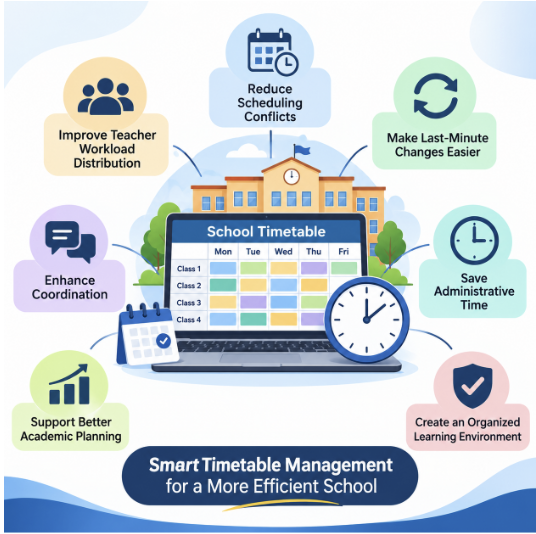
1. Reduce Scheduling Conflicts
One of the biggest challenges in school timetable planning is avoiding overlapping schedules.
For example, a teacher cannot conduct two classes at the same time, and a classroom cannot accommodate multiple groups simultaneously.
Manual scheduling increases the possibility of such errors, particularly in schools with multiple sections.
A digital scheduling system helps administrators organize:
-
Teacher availability and assigned periods.
-
Subject-wise class schedules.
-
Classroom and laboratory allocations.
-
Daily and weekly academic periods.
-
Break times and school working hours.
This makes timetable preparation more organized and reduces scheduling mistakes.
2. Improve Teacher Workload Distribution
An effective timetable should distribute teaching responsibilities fairly.
If some teachers have continuous periods while others have unnecessary gaps, it can affect productivity and classroom preparation.
Schools should consider the following factors while preparing schedules:
-
Number of teaching periods assigned to each teacher.
-
Subject requirements for different classes.
-
Available preparation time.
-
Consecutive teaching periods.
-
Teacher availability and leave schedules.
A structured scheduling process helps school management maintain a balanced workload and improve coordination among faculty members.
3. Make Last-Minute Changes Easier
Unexpected situations are common in educational institutions. Teachers may take leave, examinations may be rescheduled, or schools may need to organize special activities.
Making these changes manually can create confusion for teachers and students.
Digital timetable management allows administrators to update schedules and communicate changes more systematically.
For example, when a teacher is unavailable, administrators can review available staff and arrange an alternative teacher without unnecessarily disturbing the entire academic schedule.
This helps schools maintain continuity in classroom activities.
4. Improve Coordination Between Teachers and Administrators
Communication gaps can create problems even when a timetable is properly prepared.
Teachers may not receive updated schedules on time, or administrators may struggle to communicate changes across multiple departments.
A centralized school management platform helps bring important academic information together.
Teachers can access their assigned schedules, administrators can review class arrangements, and school management can maintain better visibility into daily academic activities.
This reduces dependence on printed timetables and repeated manual communication.
5. Save Administrative Time
Preparing and updating timetables manually requires repeated checking and coordination.
Administrators often need to verify teacher availability, classroom requirements, subject allocations, and period distribution.
Digital scheduling tools can simplify these activities by keeping information organized in one place.
The time saved can be used for other important responsibilities, such as academic planning, student support, teacher coordination, and institutional development.
6. Support Better Academic Planning
A timetable is not just a daily schedule. It also helps schools maintain consistency in their academic activities.
A properly planned timetable ensures that subjects receive appropriate attention and that academic periods are distributed according to institutional requirements.
School administrators can use structured scheduling to:
-
Maintain consistent subject periods.
-
Organize practical and laboratory sessions.
-
Schedule examinations and special classes.
-
Coordinate extracurricular activities.
-
Plan academic activities across different sections.
This creates a more organized learning environment for both teachers and students.
7. Choose a School Management System That Supports Academic Coordination
As schools grow, managing daily academic activities through spreadsheets and paper records can become increasingly difficult.
A comprehensive school management platform can help institutions centralize their administrative and academic processes.
When evaluating a solution, school administrators should look for features such as:
-
Class and teacher timetable management.
-
Teacher availability tracking.
-
Centralized academic information.
-
Role-based access for staff.
-
Easy schedule updates.
-
Integration with attendance and other school operations.
VidyalayBox provides an integrated school management platform designed to simplify institutional operations. Its academic and administrative capabilities help schools bring important activities together, improve coordination, and reduce repetitive manual work. Schools looking to modernize their daily operations can explore VidyalayBox and understand how a connected management system can support their institutional requirements.
Conclusion
Efficient timetable planning plays an important role in maintaining an organized academic environment. From avoiding scheduling conflicts to balancing teacher workloads, a structured scheduling process helps schools manage their daily responsibilities more effectively.
As educational institutions continue to adopt digital solutions, moving beyond manual scheduling can improve administrative coordination and save valuable time.
With a comprehensive school management platform in Bihar like VidyalayBox, schools can take a more organized approach to academic planning and build smoother daily operations.
Frequently Asked Questions (FAQs)
1. What is school timetable management software?
School timetable management software helps educational institutions organize class schedules, teacher assignments, subjects, classrooms, and academic periods through a digital system.
2. How does digital timetable management help teachers?
It allows teachers to access their schedules easily, understand their assigned periods, receive schedule updates, and coordinate their daily teaching responsibilities more effectively.
3. Can schools avoid timetable scheduling conflicts?
Yes. A structured digital scheduling process helps administrators identify overlapping teacher assignments, classroom conflicts, and incorrect period allocations before finalizing schedules.
4. Why is automated timetable management important for schools?
It reduces repetitive manual work, makes schedule updates easier, improves teacher coordination, and helps administrators manage academic activities efficiently.
5. Can school ERP software help manage academic schedules?
Yes. School ERP software can bring timetable planning together with attendance, student records, examinations, and other administrative activities, helping schools maintain a more organized academic environment.
Related Articles & Guides
Smart School Management Software for Patna Schools
Simplify admissions, attendance, fee collection and parent communication with smart school management software designed for modern schools.
How School Admission Software Simplifies Enrolment
Discover how school admission management software helps schools simplify applications, organize student records, reduce paperwork and improve enrolment.
School Timetable Management Software for Better Planning
Discover how digital timetable management helps schools organize classes, allocate teachers, avoid scheduling conflicts, and improve academic planning.