Managing Student Transfers with Smarter School ERP Solutions
Student transfers involve more than issuing a transfer certificate. Schools must maintain accurate academic histories, verify documents, update records, and coordinate with parents. A structured digital system can make this process easier, faster, and more reliable.

VidyalayBox Team
Education Technology Team
Managing Student Transfers Without Losing Important School Records
Student transfers are a regular part of school administration. Students may move to another city because of family relocation, parents' job changes, or other personal circumstances. While the process may appear straightforward, managing student transfers involves several administrative responsibilities.
Schools need to verify student details, prepare transfer certificates, maintain academic histories, update admission records, and ensure that important documents are properly organized.
When these activities depend entirely on paperwork and manual recordkeeping, the process can become time-consuming. A more organized digital approach can help schools manage student transfers efficiently while maintaining accurate student information.
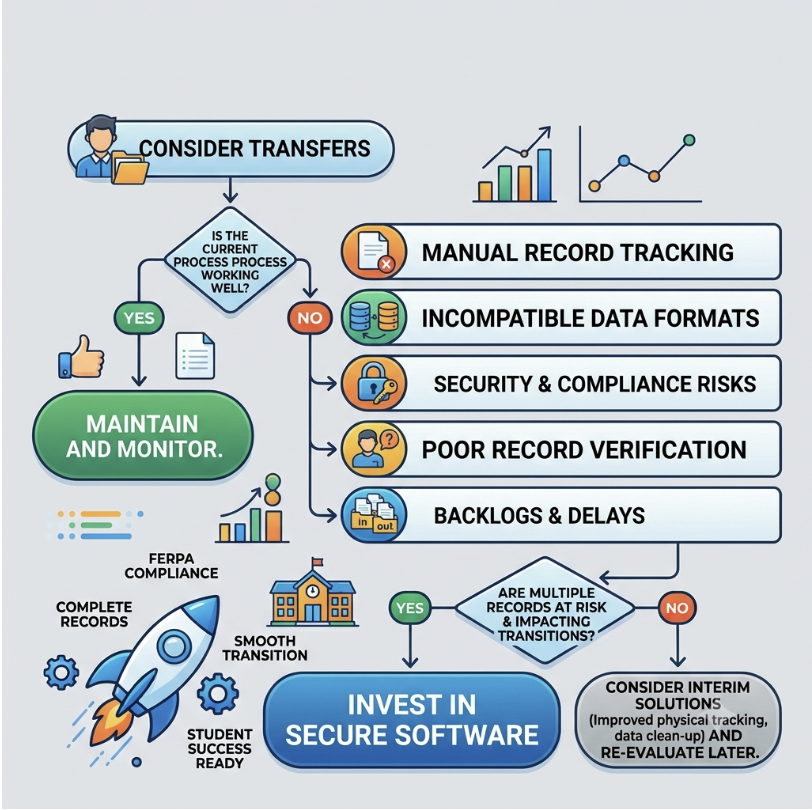
1. Why Student Transfer Management Requires Attention
A student transfer involves several records that must be handled carefully. These may include:
-
Student admission and identification details.
-
Previous academic performance.
-
Attendance history.
-
Examination and assessment records.
-
Fee payment history.
-
Transfer certificates and supporting documents.
Missing or incorrect information can create difficulties for both the student's previous school and the institution accepting the student.
Maintaining organized records helps schools provide accurate information whenever it is required.
2. Common Challenges Schools Face During Student Transfers
Many educational institutions still depend on physical files, registers, and separate spreadsheets to manage student information.
This creates several administrative challenges.
Difficulty locating old records: Finding a student's previous academic information can take considerable time when documents are stored in different departments.
Document verification delays: Staff members may need to manually check admission forms, certificates, and other supporting documents.
Repeated data entry: Updating the same student information across multiple registers increases the possibility of errors.
Communication gaps: Parents may need to visit the school multiple times to understand the status of their documentation.
Incomplete academic history: Poor record organization can make it difficult to provide a complete student profile to the receiving institution.
These challenges highlight the importance of maintaining a structured student information system.
3. How Digital Student Records Improve Transfer Management
Digital recordkeeping allows schools to maintain student information in a centralized system rather than depending entirely on physical documents.
An organized student database can help administrators:
-
Search student records using names or admission numbers.
-
Access academic and attendance histories.
-
Maintain digital copies of important documents.
-
Update student status when a transfer is completed.
-
Retrieve information whenever required.
-
Reduce unnecessary paperwork.
This approach also makes it easier for authorized school employees to access relevant information without repeatedly searching through physical files.
4. The Importance of Accurate Transfer Certificates
Transfer certificates are important documents in the student admission process. They provide essential information about a student's previous enrollment and educational background.
Schools should ensure that transfer certificates contain accurate student details, admission information, relevant dates, and other required particulars.
A digital school administration system can simplify certificate preparation by using information already available in student records.
Before issuing a certificate, authorized staff should verify all details to avoid spelling mistakes, incorrect dates, or missing information.
5. How School ERP Software Supports Better Record Management
Managing student records becomes easier when different administrative activities are connected through a centralized platform.
Schools evaluating the best school erp software in bihar should consider whether the platform supports student information management, document storage, admission records, academic histories, and administrative reporting.
A suitable platform can help school administrators maintain organized records while reducing repetitive data entry.
Important capabilities to consider include:
Student Information Management: Maintain student profiles, contact details, academic histories, and important documents.
Document Management: Store and retrieve relevant student documents digitally.
Admission Management: Organize admission details and student enrollment information.
Academic Records: Maintain examination results, attendance information, and academic progress.
Role-Based Access: Allow authorized employees to access information according to their responsibilities.
These capabilities can help schools maintain better administrative control and improve record accuracy.
6. What Schools Should Consider Before Implementing a Digital System
Before adopting a new software platform, school administrators should understand their existing documentation process and identify areas that require improvement.
Here are some important considerations:
-
Understand current requirements: Identify how student records, transfer certificates, and academic documents are currently maintained.
-
Review essential features: Select software that supports the school's actual administrative requirements.
-
Plan data migration: Organize existing student information before moving it into a digital platform.
-
Train administrative staff: Ensure employees understand how to update, retrieve, and manage student records.
-
Maintain data security: Use appropriate access permissions, backups, and security measures.
-
Review the system regularly: Check whether records remain accurate and administrative processes are improving.
A planned implementation makes the transition easier for school employees and administrators.
7. Building a More Organized School Administration System
Student transfer management is just one part of the larger administrative responsibilities handled by educational institutions.
Schools also need to manage admissions, examinations, fee records, attendance, communication, and academic reporting.
When these activities operate through disconnected systems, administrative teams may spend unnecessary time collecting and verifying information.
VidyalayBox provides an integrated school management platform designed to help educational institutions organize their everyday operations. Its features support student information management, admissions, attendance, examinations, fee management, and other essential administrative activities.
By bringing important school processes together, digital school management can help administrators maintain better visibility over institutional operations.
Conclusion
Student transfers require careful handling of academic records, documents, and administrative information. Even small mistakes can create unnecessary difficulties for students, parents, and school staff.
Moving towards organized digital record management can help educational institutions reduce paperwork, improve information accuracy, and simplify administrative activities.
Schools looking for the best school erp software in biharshould evaluate solutions that support their documentation requirements, student information management, and everyday administrative workflows.
With the right digital system, schools can make record management more organized and provide a smoother administrative experience for students and parents.
Explore VidyalayBox at https://vidyalaybox.com/ to learn more about its school management solutions.
Frequently Asked Questions (FAQs)
1. Why is student transfer management important for schools?
Student transfer management ensures that academic histories, attendance records, admission details, and required documents are properly maintained when students move to another institution.
2. What documents are generally required during a student transfer?
Common documents include transfer certificates, previous academic records, identification details, and other documents required by the receiving school.
3. How can schools reduce errors in student records?
Schools can reduce errors by maintaining centralized digital records, verifying information before updating it, restricting editing permissions, and conducting regular data reviews.
4. Can school ERP software help manage student documents?
Yes. Depending on its features, school ERP software can help schools store, organize, retrieve, and update student documents through a centralized platform.
5. What should schools consider when selecting school management software?
Schools should evaluate student information management, admission features, fee management, attendance tracking, examination management, document handling, data security, usability, and technical support.
Related Articles & Guides
Smart School Management Software for Patna Schools
Simplify admissions, attendance, fee collection and parent communication with smart school management software designed for modern schools.
How School Admission Software Simplifies Enrolment
Discover how school admission management software helps schools simplify applications, organize student records, reduce paperwork and improve enrolment.
School Timetable Management Software for Better Planning
Discover how digital timetable management helps schools organize classes, allocate teachers, avoid scheduling conflicts, and improve academic planning.